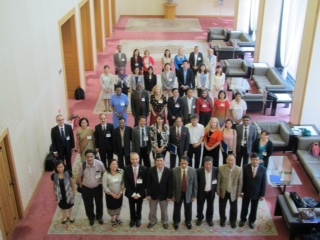
Thanking members of the #CodexAlimentarius Commission and Congratulating the new chair

1_Codex50_Menu_NoWritings

Statement made by Samuel Godefroy at the opening of the morning session of Wednesday, July 16th, 2014 – during the 37th session of the Codex Alimentarius Commission: 

I would like to renew my congratulations to Ms. Awilo Ochieng Pernet for having been elected Chair of the Codex Alimentarius Commission with such a broad level of support from Commission members.

I would like to wish her all the success in leading our deliberations and in advancing the mandate and upholding the principles of Codex.

I would like to acknowledge and thank our current Chair, Sanjay Dave, for his leadership and for his wise guidance to all three of us, Ms. Ochieng-Pernet, Professor Sefa Dede and myself, during our tenure as Vice-Chairs of Codex.

I would like to add two words of acknowledgement:

–  I would like to acknowledge the commitment of the Government of Canada to the Codex Alimentarius Commission, for presenting and supporting my candidacy to seek the position of Chair of the Commission.

– I would also like to acknowledge our small, but ever so entrepreneurial campaign team for their support to me, in shaping a vision and proposal for Codex. I would like to thank you all, members of the Commission for the way you responded to this proposal and for enriching this vision with your views and suggestions.

I was very much humbled by your expressions of support and your kind encouragement to me, during the campaign and after the announcement of the election results. I know that through this experience, I have gained and strengthened many friendships among our Codex family, and for that I am so grateful.

Thank you again.

Some thoughts on #CodexAlimentarius Achievements and Challenges ahead, published in Int’l #Food Risk Analysis J.

This paper, published in the International Food Risk Analysis Journal, attempts to present some of the key accomplishments of the Codex Alimentarius Commission over the past 50 years, viewed through my own lens as a food scientist and a food regulator. It also offered me the opportunity to share some of my views as to a few challenges that I have identified and that the organisation is facing currently and in the near future with suggestions as to how possibly address them.

I welcome input of the Codex membership and peer food safety, nutrition and food quality scientists and regulators on these thoughts and considerations.

IFRAJ-Eng

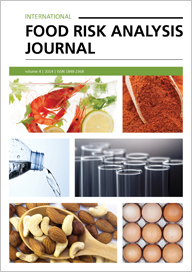
Special issue dedicated to #Codex published in Int’l Food Risk Analysis Journal

IFRAJ picIFRAJ-Eng

A special issue of the International Food Risk Analysis Journal (IFRAJ) was made available recently and is dedicated to the activities of the Codex Alimentarius Commission.

This issue offers the proceedings of the special session dedicated to celebrate the 50th anniversary of the Codex Alimentarius Commission (Codex), organized at part of the China International Food Safety and Quality Conference (CIFSQ) in Beijing, China from 6-7 November 2013. This “Codex” session had the following theme: “Codex Alimentarius Commission at 50, Accomplishments and Future Challenges”. The session gathered key opinion leaders and contributors to Codex from around the world and particularly from the Asia-Pacific Region. It aimed at highlighting the accomplishments of the Codex Alimentarius Commission over the past 50 years as the preeminent food standard setting body internationally, its future challenges and areas of focus both internationally and for the Asia – Asia-Pacific region in particular. The session also highlighted the critical nature of the availability of scientific advice delivered by the expert advisory bodies to Codex led by the World Health Organization and the United Nations Food and Agriculture Organization, as well as the importance of availability of data from countries and organizations to inform the development of such scientific advice. The session discussed the contribution of scientific and regulatory institutions in the region and elsewhere to generate and foster the availability of scientific information critical to standard setting domestically and internationally.

I had the privilege to be the organizer of this special session at CIFSQ and editor of this special issue of the IFRAJ dedicated to Codex. I would like to thank all speakers that have kindly agreed to contribute to this issue. My thanks go to the current chair of the Commission, Dr. Sanjay Dave, for his support to the organization of this session as well for his participation and his contribution with a paper to this special issue. A special thanks go to former Chair Dr. Karen Hulebak for agreeing to preface this special issue.


Great opportunity to engage with CCASIA colleagues during their #CodexAlimentarius Colloquium

Honored to join participants of the CCASIA Codex Colloquium - in preparation of CAC 37.

Honored to join participants of the CCASIA Codex Colloquium – in preparation of CAC 37.

I was honored to take part in the CCASIA Codex Colloquium co-organised by the Government of Japan, as the Coordinator for the Asia region and the US Department of Agriculture from June 25-27, 2014 in Tokyo. The meeting gathered representatives of most of the member countries of CCASIA, as well as colleagues from the United States, Brazil and Mali. The meeting focused on discussing the outcomes of the most recent Codex Committee meetings and the proposed items referred to the Commission for its consideration: standards in progress, standards for adoption and new proposed work.


Enjoying exchange of views and opportunities to discuss Codex challenges and future directions with peers and colleagues from Pakistan, Vietnam and Mali.

Enjoying exchange of views and opportunities to discuss Codex challenges and future directions with peers and colleagues from Pakistan, Vietnam and Mali.

The meeting was a great opportunity for me, to engage directly with colleagues from the Asian region and discuss their Codex priorities, their challenges as well as opportunities for shaping a vision for the agenda of Codex in the upcoming years, building on the direction provided by the Codex Strategic Plan 2014-19. I was able to raise with peers and colleagues a number of themes of focus such as the ability of Asian countries to contribute systematically to Codex work through provision of data or through the assessment of the impacts of proposed Codex standards on their food sector in their respective countries. Similarly, the ability to harness existing scientific resources in the region and devote them to serve Codex needs and to support data gathering and submission from the region, in response to calls for data by FAO and WHO, was also discussed.


With Dr. Yayoi Tsujiyama (Japan), Dr.Mahamadou Sako (Mali) and Dr. Gilherme Costa (Brazil) candidates for Vice chairperson position of the CAC in 2014.

With Dr. Yayoi Tsujiyama (Japan), Dr.Mahamadou Sako (Mali) and Dr. Gilherme Costa (Brazil) candidates for Vice chairperson position of the CAC in 2014.


This meeting enabled me to exchange views on the furture agenda of Codex with my colleagues Dr. Yayoi Tsujiyama (Japan), Dr. Mahamadou Sako (Mali) and Dr. Gilherme Costa (Brazil), candidates for the Vice Chairperson position of Codex.


I would like to convey my most sincere appreciation to the meeting organisers for their invitation to contribute to these discussions and thank our Japanese hosts for their outstanding hospitality.

Labelling of mechanically tenderized beef – Publication in Canada Gazette Part II and guidance document

Health Canada published its final regulatory requirements related to mandatory labeling of mechanically tenderized beef in part II of the Canada Gazette on May 21st, 2014.

In comparison to the initial set of requirements previously described on this blog, you will note that some changes were introduced to ensure more flexibility of application of the labeling requirements where applicable, while maintaining the main objective of ensuring that consumers are duly informed when beef is mechanically tenderized through a statement on the label, in a consistent and clear fashion. These changes are the result of the consultation process and the feed-back from the stakeholder community.

Health Canada’s Food Directorate published a guidance document to support the industry sector’s readiness for the implementation of these requirements upon the coming into force of the regulations, planned for August 2014.

Proposed lower tolerances for Arsenic and Lead in selected foods sold in Canada – Consultation

Health Canada’s Food Directorate is proposing to update certain regulatory tolerances for arsenic and lead in a variety of beverages, including bottled water.

Arsenic and lead are present in the environment at low levels as a result of their natural occurrence and release related to human activity, including industrial activity. The levels of arsenic and lead in foods available in Canada have been stable at very low levels for many years; these trace amounts typically reflect the expected accumulation from the environment.

Health Canada proposes to reduce the tolerance for lead in fruit juice, fruit nectar, and beverages when ready-to-serve, to the level of 0.05 ppm or 0.05 milligram per Liter, 4 times lower than the current level. Health Canada also proposes that the maximum tolerance for lead in bottled water be reduced to 0.01 ppm or 0.01 milligram per Liter.

These levels were deemed to be achievable and are consistent with the tolerances established by the Codex Alimentarius Commission: the International food standard setting body.

For arsenic, the focus is on apple juice and bottled water. Apple juice is the most frequently consumed juice by young children in Canada and was therefore subject to particular focus as a potential significant source of exposure to this vulnerable group of our population. Health Canada proposes that the maximum tolerance for total arsenic be set at 0.01 ppm or 0.01 milligram per Liter for both bottled water and apple juice. Setting levels for total arsenic rather than inorganic arsenic (which is the toxic form for arsenic) allows an increased level of protection and is more easily complied with and enforceable by regulators, given the wide range of available methods to measure total arsenic in food (as opposed to inorganic arsenic, for which methods are more complex and possibly less accessible to industry).

Health Canada’s rationale for these changes as well as the consultation document are available on its Food and Nutrition Webpages.

The proposed lower tolerances are more protective of human health than those that currently exist.  Lowering these tolerances aligns with Health Canada’s general commitment to reduce dietary exposure to contaminants, and lead and arsenic in particular, to levels that are as low as reasonably achievable (ALARA)

The consultation is open and comments can be sent to Health Canada’s Food Directorate, Bureau of Chemical Safety until September 1st, 2014.

Report on consultations with Canadian parents and consumers on nutrition labeling

The Honorable Rona Ambrose, Minister of Health  released the report stemming from the consultations with Canadian consumers and parents on nutrition labeling.

The report can be accessed via this link : Consultation report on modernizing and improving food labels in Canada

Canada continues to be a world leader in nutrition labelling of pre-packaged foods, with the aim to provide consumers with the relevant information that supports their food choices and the management of their diet. Unhealthy diets and limited physical activity have been associated with the increase of rates of Chronic Disease. Improved food labels would therefore contribute to prevention efforts of these non-communicable diseases.

The publication of this report is an important milestone in the continued efforts committed by the Government of Canada and Health Canada to improve the quality, relevance and usefulness of nutrition information displayed on labels of foods sold in Canada.

A great opportunity to meet food stakeholders at the 2nd World Food Safety Conference


Second World Food Safety Conference Bangkok – Thailand 22-23 May 2014

Discussing Food Safety Standards challenges

Discussing Food Safety Standards challenges

On May 23, 2014, I was privileged to contribute to the Second World Food Safety Conference held in Bangkok Thailand, by making a presentation reviewing the drivers influencing food standard setting internationally and the resulting trends. The presentation made the case for the necessity of enhanced worksharing and collaboration amongst food regulators regionally and internationally, aiming for added efficiency and convergence in food regulatory requirements. The need to align standard development with the principles and outputs of the Codex Alimentarius Commission, as the preeminent international food standard setting body was highlighted. Participating in the meeting provided me with an excellent opportunity to discuss with a number of food stakeholders in Thailand, in Asia and the Asia Pacific region overall current and emerging challenges related to food safety and nutrition.

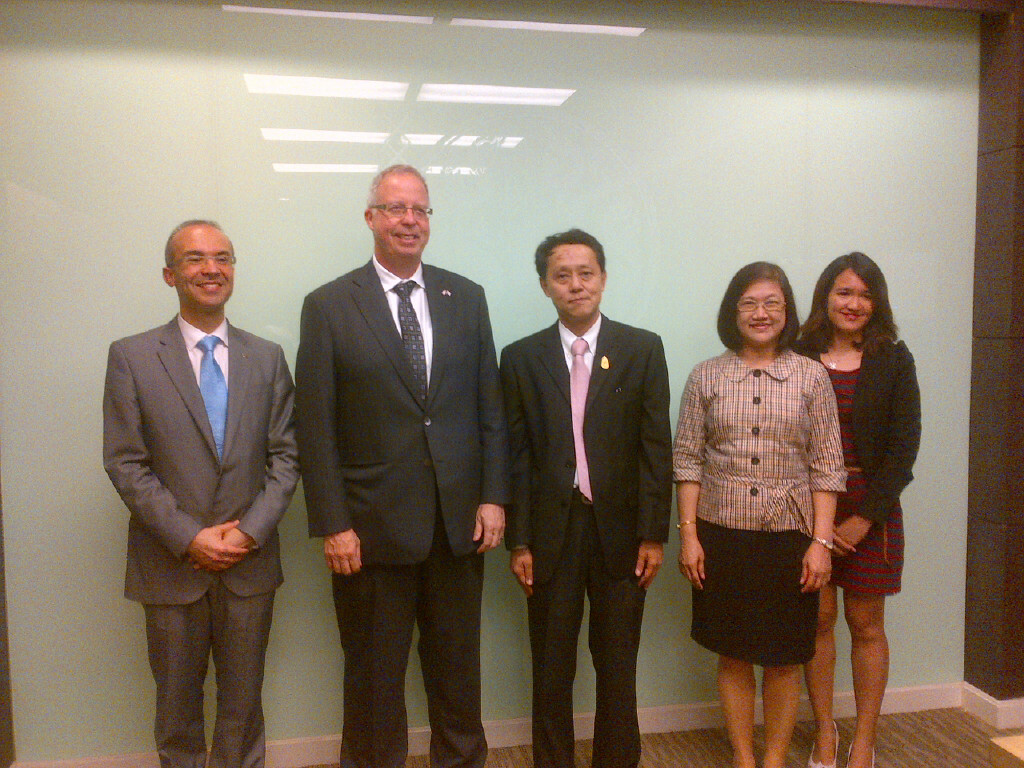
With Dr. Pisan Pongsapitch and his team and with H.E. Ambssador Philip Calvert, Canadian Ambassador to the Kingdom of Thailand

With Dr. Pisan Pongsapitch and his team and with H.E. Ambassador Philip Calvert, Canadian Ambassador to the Kingdom of Thailand

My visit to Thailand gave me the opportunity to meet and exchange with peer food safety regulators and colleagues from Thailand, particularly Dr. Pisan Pongsapitch, Director of Standard Development, in the Thai Department of Agriculture and his team. My thanks and gratitude to our Thai hosts for their kind and generous hospitality

With Dr. Pisan Pongsapitch, Director of Standard Development, Thai Ministry of Agriculture

With Dr. Pisan Pongsapitch, Director of Standard Development, Thai Ministry of Agriculture

Advice about microbial safety of donor human milk in Canada

Health Canada’s Food Directorate has published a Questions and Answers document on the microbiological safety of donor human milk in Canada. This document was developed to advise Canadians about the risks associated with the consumption of human milk obtained from the Internet or directly from individuals. This document also offers general guidance related to donor human milk.
The document is available at the following link.

Proposed Risk Analysis Approach to set Maximum Levels for Vitamins & Minerals in Supplemented Foods – for Consultation

Health Canada’s Food Directorate scientists have published in the “Risk Analysis Communications” Section of the International Food Risk Analysis Journal (IFRAJ), their proposed risk analysis-based approach to set maximum levels for the addition of vitamins and minerals to food products that would become eligible for Temporary Marketing Authorization, as supplemented foods. This technical paper is open for consultation during a period of 60 days, starting June 2nd, 2014. Comments can be sent to smiu-ugdi@hc-sc.gc.ca

The paper is accessible through the link attached.