Mise à jour de l’évaluation de l’avoine pure et son innocuité dans le cadre d’un régime “sans gluten”

Écrit par : Samuel Godefroy – Toute opinion n’engage que ma personne sans aucun engagement par mon employeur

Les scientifiques de la Direction des aliments de Santé Canada ont mis à jour leur évaluation scientifique sur l’innocuité de l’avoine spécialement produite, avant d’être introduite dans un régime “sans gluten”. Cette avoine produite sans être contaminée par d’autres céréales telles que le blé ou l’orge a été jugée sécuritaire pour être introduite progressivement dans un régime “sans gluten” pour les personnes céliaques.

Les détails de cette évaluation ont été publiés et sont ouverts à commentaire jusqu’à la fin janvier 2015.

Les commentaires  pourront être envoyés à l’adresse suivante: fooddirectorate-directiondesaliments@hc-sc.gc.ca

Plus de détails via le lien suivant : Consultation de Santé Canada sur l’allégation sans gluten pour l’avoine pure

Evidence supporting #glutenfree claims for specially produced oats – available for comments

Health Canada’s Food Directorate scientists reviewed and updated the evidence that supports the safety for Celiac individuals of specially produced oats i.e., oats that are produced in a manner that makes them pure and uncontaminated with other cereal grains such as wheat and barley. The conclusion of this review is that these oats are safe to be introduced in a “gluten-free” diet for the majority of celiac individuals. The evidence is open for consultation and input from the stakeholder community until the end of January 2015. Input should be provided to  fooddirectorate-directiondesaliments@hc-sc.gc.ca

More information on Health Canada’s consultation is available via this link:  Health Canada’s consultation on “Gluten free” claims for pure and uncontaminated oats

Blog post by Samuel Godefroy : Opinions are personal with no attribution to my employer

La #DirectiondesAliments de Santé Canada met à jour ses partenaires sur ses activités – #ChroniqueAlimentaire Sept 2014

La direction des aliments de Santé Canada a partagé avec ses partenaires et parties prenantes une nouvelle édition de la Chronique Alimentaire pour le mois de Septembre 2014. Cette édition rappelle les principales initiatives et activités de la direction pour le mois écoulé et sollicite le retour des parties prenantes sur certaines activités en cours.

Pour demander à être inclus directement sur la liste de transmission de cette chronique au moment de sa publication, veuillez communiquer avec food-aliment@hc-sc.gc.ca


Health Canada’s #FoodDirectorate updates partners and stakeholders on its Sept2014 activities – #FoodTimes

Health Canada’s Food Directorate shared with partners and stakeholders, the September 2014 issue of Food Times. This issue reports on recent accomplishments, publications and engagement activities conducted by the Directorate during the month of September 2014.

Should you wish to be included in the list of stakeholders and receive this issue directly, please contact food-aliment@hc-sc.gc.ca

APEC Food Safety Cooperation Forum : High level Regulator Industry Dialogue – Towards stronger partnership to promote #foodsafety in the region

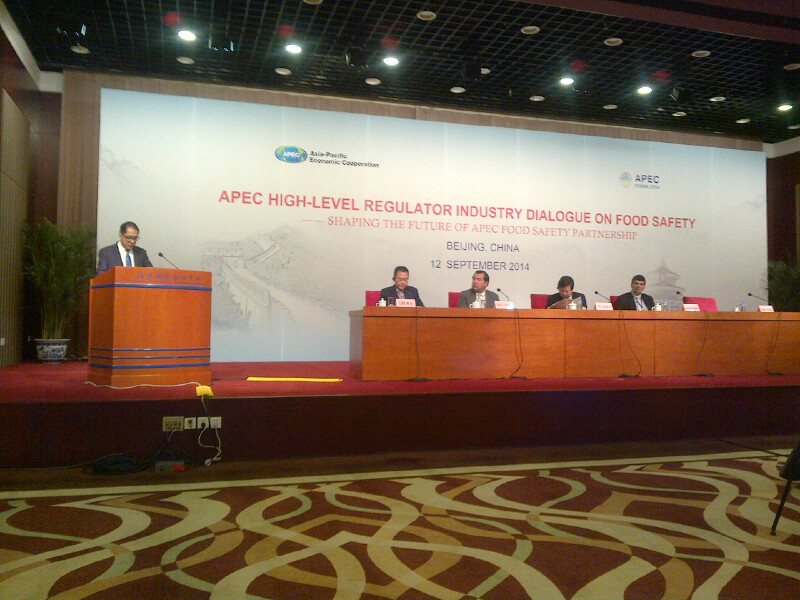
On September 12th, 2014, the Asia Pacific Food Safety Cooperation Forum (FSCF) co-chaired by China and Australia convened food regulators, industry representatives, academia and other food stakeholders in the region to a “High Level Regulator Industry Dialogue on food safety” on the margin of the organization of the special meeting of the FSCF held on September 13th in Beijing.

2014.9.12Participants acknowledged the complementary nature of roles and responsibilities of all stakeholders in particular of industry and regulators in ensuring food safety and discussed avenues to enhance such collaboration.


IMG-20140912-00042Participants agreed to make 4 recommendations to the FSCF:

  • To enhance communication and collaboration between food safety regulators and industry under the auspices of the FSCF, recognizing the benefits of public-private partnerships,
  • To ensure that food safety regulators continue their commitment to transparency in policy development, in adopting good regulatory practices, the use of science-based international food safety standards and the opportunity for industry and stakeholder engagement in developing food regulatory measures,
  • To enhance ability of the food industry and food industry associations in the region to comply with food safety requirements, standards and best practices through dedicated capacity building activities with a possible focus on small and medium enterprises and
  • To enhance capabilities of APEC member economies and food industry using the established FSCF Partnership Training Institute Network (PTIN).

These recommendations were considered and supported by representatives of APEC member economies during the meeting of the FSCF held on September 13th, 2014. Enhancing collaboration between food stakeholders to support food safety will be one of the themes further discussed at the next meeting of the FSCF hosted by the Philippines in 2015.

La #Directiondesaliments de SC met à jour ses intervenants sur ces activités – Chronique Alimentaire – Août 2014

La Direction des aliments de Santé Canada a partagé avec ses parties prenantes et intervenants une mise à jour de ses activités clés pour la période du mois d’août 2014.

La Chronique alimentaire, deviendra désormais une publication mensuelle, utilisant une version abrégée, mais poursuivant l’objectif de maintenir et renforcer l’implication des parties prenantes de manière plus régulière et plus efficace.

Des commentaires sur cette nouvelle approche sont les bienvenus en écrivant à food-aliment@hc-sc.gc.ca

HC’s #FoodDirectorate updates stakeholders on accomplishments and on-going initiatives – #FoodTimes August 2014

Health Canada’s Food Directorate shared with stakeholders an update on its key accomplishments and on-going initiatives for August 2014.

Food Times, previously published on quarterly basis, will be now shared with stakeholders monthly, using a shorter, abbreviated version. This change is meant to enhance transparency and on-going stakeholder engagement by Health Canada’s Food Directorate, as a primary food standard setter in Canada.

Comments and input on this updated approach are welcome and can be sent to food-aliment@hc-sc.gc.ca

Updating the #AOAC Food Allergen Community on latest accomplishments and future direction in capacity building re. food allergen management

During tonight’s meeting of the of the Food Allergen Community of AOAC International (International Association of Official Analytical Communities), I will attempt to  provide an overview of the latest accomplishments and future directions related to capacity building initiatives associated with  food allergen management and supported by the Government of Canada. I will focus on our recent efforts under the auspices of the Asia-Pacific (APEC) Food Safety Cooperation Forum and the workshop co-organised by Health Canada’s Food Directorate and FARRP last May.

An effort to further document and map capacity building needs in this area, for the region will be attempted during the upcoming China International Food Safety and Quality Conference, where we are aiming to organise a dedicated session on food allergens, on November 6th, 2014 in Shanghai.


#AOAC Food Allergen Community to meet tomorrow / Update on our recent activities to enhance food allergen management

During the upcoming meeting of the AOAC International (International Association of Official Analytical Communities), on September 9th, 2014, experts of the Food Allergen Community will be seeking and providing updates on their latest accomplishments and current challenges in the area of food allergen management, method development and validation as well as capacity building initiatives.

I will use this opportunity to provide the community (remotely) with an update on our recent capacity building activities under the auspices of the Asia/Pacific Food Safety Cooperation Forum to support improved practices of food allergen management by industry and regulators.

I am embedding in this post, the introductory remarks I had the opportunity to make during the Food Allergen Methodologies Workshop, held in Vancouver, British Columbia, in May 2014, co-organised by Health Canada’s Food Directorate and the Food Allergy Research and Resource Program (FARRP) of the University of Nebraska.

These remarks attempt to put in context these efforts of capacity building and the importance of our continued investment to promote knowledge transfer related to allergen management amongst food safety stakeholders.