Glad to contribute in #AOAC Int’l efforts to focus its priorities on food safety

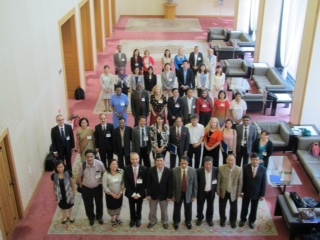
I had the privilege of contributing to an expert panel discussion held under the auspices of the stakeholder group advising AOAC International on food standard development. The panel discussion was held ahead of AOAC’s annual meeting on Sept. 7th. I was accompanied on this panel by two illustrious colleagues and food safety experts, Dr. David Acheson (Acheson Group) and Dr. Bob Bracket ( Institute for Food Safety and Health). This was an opportunity to discuss drivers of change governing food safety and leading to emerging food safety issues. These efforts are part of an on-going discussion undertaken by AOAC and its stakeholder community leading to consider food safety as an area of focus for its food-related method development and validation initiatives.
My contribution focused on emerging issues associated with food chemical safety and the newly introduced notion of nutrition safety.

For more information on the AOAC Food Safety initiative, please contact Dawn Frazier, Executive for scientific business development.
Nouvelles lignes directrices sur l’étiquetage relatif à la préparation et cuisson de viandes hachées

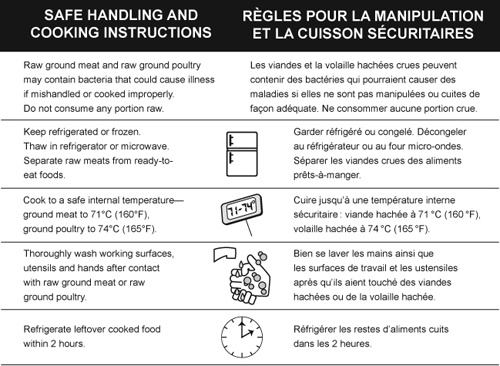
guide-cook-cuiss-meat-viand-01Santé Canada a publié de nouvelles lignes directrices sur l’étiquetage de viandes hachées relatives à leur préparation et cuisson. Ces lignes directrices visent à rendre plus uniforme l’information inscrite sur ces étiquettes et permettent de renseigner le consommateur sur les précautions à prendre pour manipuler et cuire ces viandes, notamment les températures de cuisson qu’il est nécessaire d’atteindre pour réduire le risque lié aux pathogènes alimentaires. Ces directives, lorsque suivies par l’industrie permettront d’uniformiser les étiquettes des viandes hachées offertes à la vente et contribueront ainsi aux efforts d’éducation et de dissémination de l’information auprès des consommateurs, sur les bonnes pratiques de manipulation et de cuisson de ces viandes.

Entrée en vigueur du nouveau réglement d’étiquetage du boeuf attendri mécaniquement

Santé Canada a confirmé la mise en vigueur du réglement sur l’étiquetage obligatoire du boeuf mécaniquement attendri, et ce à compter d’aujourd’hui 21 août, 2014.

mech-tenderized-beef-boeuf-attendris-meca-02La direction des aliments de Santé Canada avait préalablement publié des lignes directrices sur la manière dont ce réglement devrait s’appliquer pour les différents types de viandes et emballages, lorsque le produit est mécaniquement attendri.

Ces mesures visent à introduire plus d’uniformité quant à la façon dont l’information utile au choix du consommateur permettant d’identifier ces produits, devrait être présentée sur l’étiquette. De même l’information requise sur l’étiquette vise à fournir les conseils nécessaires de préparation de ce type de produit, telles les températures de cuisson à respecter, afin d’accroitre la protection des consommateurs et de prévenir des incidents alimentaires.

Enhanced meat labeling requirements and guidance to support #foodsafety

Example of Mechanically Tenderized Beef Labeling according to the new regulations / Exemple d'étiquetage requis par le nouveau régelement

Example of Mechanically Tenderized Beef Labeling according to the new regulations / Exemple d’étiquetage requis par le nouveau réglement

Canada’s new labeling requirements for mechanically tenderized beef are in effect as of today, August 21st, 2014. Health Canada announced the coming into force today on its website.

In June 2014, Health Canada’s Food Directorate issued guidance on how these regulatory requirements are to be implemented. This guidance was previously discussed on this blog.

mech-tenderized-beef-boeuf-attendris-meca-02

These requirements are meant to create consistency in the way information is displayed on food labels, to support consumer choice and enable enhanced food safety practices such as following the relevant advice about cooking temperatures, as an additional measure to prevent foodborne illnesses.

Additional guidance was also made available by Health Canada to support consistency of labeling for raw meat and poultry . This guidance, when followed by processors and retailers, will result in labels that clearly display safe handling information useful to consumers to prevent food safety incidents and food borne illnesses.

Example of best practices  to present safe handling information on ground meat labels

Example of best practices to present safe handling information on ground meat labels


An excellent Reference outlining “Risk Analysis in Food Regulations” made available by #FSANZ

A few months ago, Food Standards Australia New-Zealand (FSANZ) has made available a document outlining its approach in developing food standards, following a risk analysis approach.

The document entitled “Risk Analysis in Food Regulations” provides an excellent overview of FSANZ’s approach in addressing various food safety and nutrition hazards within the mandate of this bi-national food safety regulator, including the identification of food hazards and the associated risks, the assessment of these risks and the development of risk management measures and their implementation.

The reader of this document will rapidly note that FSANZ’s approach is very much aligned with the international food risk analysis principles adopted by the Codex Alimentarius Commission.

I was privileged to be given the opportunity to be one of the peer reviewers of this document, prior to its publication in January 2014. I consider this document as an excellent reference for food regulators and food stakeholders alike.

FSANZ is to be commanded for its enhanced transparency efforts and its leadership in making such a reference document available to all of us.


Latest issue of the #AOAC #FoodAllergen Community is available

You will find in this issue the latest updates for food regulatory changes related to food allergen labeling internationally, including a review of the situation in MERCOSUR countries. Some updates on latest research related to food allergen analytical development are also highlighted.

Thanks to the Editorial team of the AOAC Food Allergen Community Newsletter for putting this newsletter together and maintaining the link between Food Allergen analytical experts and other colleagues interested in this area.

I look forward to seeing many of you during our upcoming annual meeting in the United States.

Thanking members of the #CodexAlimentarius Commission and Congratulating the new chair

1_Codex50_Menu_NoWritings

Statement made by Samuel Godefroy at the opening of the morning session of Wednesday, July 16th, 2014 – during the 37th session of the Codex Alimentarius Commission: 

I would like to renew my congratulations to Ms. Awilo Ochieng Pernet for having been elected Chair of the Codex Alimentarius Commission with such a broad level of support from Commission members.

I would like to wish her all the success in leading our deliberations and in advancing the mandate and upholding the principles of Codex.

I would like to acknowledge and thank our current Chair, Sanjay Dave, for his leadership and for his wise guidance to all three of us, Ms. Ochieng-Pernet, Professor Sefa Dede and myself, during our tenure as Vice-Chairs of Codex.

I would like to add two words of acknowledgement:

–  I would like to acknowledge the commitment of the Government of Canada to the Codex Alimentarius Commission, for presenting and supporting my candidacy to seek the position of Chair of the Commission.

– I would also like to acknowledge our small, but ever so entrepreneurial campaign team for their support to me, in shaping a vision and proposal for Codex. I would like to thank you all, members of the Commission for the way you responded to this proposal and for enriching this vision with your views and suggestions.

I was very much humbled by your expressions of support and your kind encouragement to me, during the campaign and after the announcement of the election results. I know that through this experience, I have gained and strengthened many friendships among our Codex family, and for that I am so grateful.

Thank you again.

Some thoughts on #CodexAlimentarius Achievements and Challenges ahead, published in Int’l #Food Risk Analysis J.

This paper, published in the International Food Risk Analysis Journal, attempts to present some of the key accomplishments of the Codex Alimentarius Commission over the past 50 years, viewed through my own lens as a food scientist and a food regulator. It also offered me the opportunity to share some of my views as to a few challenges that I have identified and that the organisation is facing currently and in the near future with suggestions as to how possibly address them.

I welcome input of the Codex membership and peer food safety, nutrition and food quality scientists and regulators on these thoughts and considerations.

IFRAJ-Eng

Special issue dedicated to #Codex published in Int’l Food Risk Analysis Journal

IFRAJ picIFRAJ-Eng

A special issue of the International Food Risk Analysis Journal (IFRAJ) was made available recently and is dedicated to the activities of the Codex Alimentarius Commission.

This issue offers the proceedings of the special session dedicated to celebrate the 50th anniversary of the Codex Alimentarius Commission (Codex), organized at part of the China International Food Safety and Quality Conference (CIFSQ) in Beijing, China from 6-7 November 2013. This “Codex” session had the following theme: “Codex Alimentarius Commission at 50, Accomplishments and Future Challenges”. The session gathered key opinion leaders and contributors to Codex from around the world and particularly from the Asia-Pacific Region. It aimed at highlighting the accomplishments of the Codex Alimentarius Commission over the past 50 years as the preeminent food standard setting body internationally, its future challenges and areas of focus both internationally and for the Asia – Asia-Pacific region in particular. The session also highlighted the critical nature of the availability of scientific advice delivered by the expert advisory bodies to Codex led by the World Health Organization and the United Nations Food and Agriculture Organization, as well as the importance of availability of data from countries and organizations to inform the development of such scientific advice. The session discussed the contribution of scientific and regulatory institutions in the region and elsewhere to generate and foster the availability of scientific information critical to standard setting domestically and internationally.

I had the privilege to be the organizer of this special session at CIFSQ and editor of this special issue of the IFRAJ dedicated to Codex. I would like to thank all speakers that have kindly agreed to contribute to this issue. My thanks go to the current chair of the Commission, Dr. Sanjay Dave, for his support to the organization of this session as well for his participation and his contribution with a paper to this special issue. A special thanks go to former Chair Dr. Karen Hulebak for agreeing to preface this special issue.


Great opportunity to engage with CCASIA colleagues during their #CodexAlimentarius Colloquium

Honored to join participants of the CCASIA Codex Colloquium - in preparation of CAC 37.

Honored to join participants of the CCASIA Codex Colloquium – in preparation of CAC 37.

I was honored to take part in the CCASIA Codex Colloquium co-organised by the Government of Japan, as the Coordinator for the Asia region and the US Department of Agriculture from June 25-27, 2014 in Tokyo. The meeting gathered representatives of most of the member countries of CCASIA, as well as colleagues from the United States, Brazil and Mali. The meeting focused on discussing the outcomes of the most recent Codex Committee meetings and the proposed items referred to the Commission for its consideration: standards in progress, standards for adoption and new proposed work.


Enjoying exchange of views and opportunities to discuss Codex challenges and future directions with peers and colleagues from Pakistan, Vietnam and Mali.

Enjoying exchange of views and opportunities to discuss Codex challenges and future directions with peers and colleagues from Pakistan, Vietnam and Mali.

The meeting was a great opportunity for me, to engage directly with colleagues from the Asian region and discuss their Codex priorities, their challenges as well as opportunities for shaping a vision for the agenda of Codex in the upcoming years, building on the direction provided by the Codex Strategic Plan 2014-19. I was able to raise with peers and colleagues a number of themes of focus such as the ability of Asian countries to contribute systematically to Codex work through provision of data or through the assessment of the impacts of proposed Codex standards on their food sector in their respective countries. Similarly, the ability to harness existing scientific resources in the region and devote them to serve Codex needs and to support data gathering and submission from the region, in response to calls for data by FAO and WHO, was also discussed.


With Dr. Yayoi Tsujiyama (Japan), Dr.Mahamadou Sako (Mali) and Dr. Gilherme Costa (Brazil) candidates for Vice chairperson position of the CAC in 2014.

With Dr. Yayoi Tsujiyama (Japan), Dr.Mahamadou Sako (Mali) and Dr. Gilherme Costa (Brazil) candidates for Vice chairperson position of the CAC in 2014.


This meeting enabled me to exchange views on the furture agenda of Codex with my colleagues Dr. Yayoi Tsujiyama (Japan), Dr. Mahamadou Sako (Mali) and Dr. Gilherme Costa (Brazil), candidates for the Vice Chairperson position of Codex.


I would like to convey my most sincere appreciation to the meeting organisers for their invitation to contribute to these discussions and thank our Japanese hosts for their outstanding hospitality.