Innovation in Food and Feed Safety – Great Conference Program offered by IFA Tulln/BOKU

I feel privileged to contribute to the upcoming conference organized by IFA/Tulln – BOKU under the leadership of Professor Rudolf Krska, and related to Innovation in Food and Feed Safety – Education, Risk Analysis and Novel Technologies. This event is held on April 5th, 2016 in Tulln Austria.

This is a model for open scientific events to share the latest developments and to introduce a number of multi-year initiatives in research and capacity development in food safety and quality. In particular, the project MyToolBox, aiming to foster a set of tools to assess and mitigate risks associated with Mycotoxins in food, will be introduced, as a major EU food safety funded initiative with global outreach.

It is also our opportunity at the Department of Food Science (Faculty of Agriculture and Food Science) of University Laval, Québec, QC (Canada) and at the Institute of Nutrition and Functional Foods, to engage with and learn from peer institutions with the aim to foster collaborations in our areas of development:  food risk analysis and competency development domestically and internationally.

The proposed agenda for the conference is attached:


Aiming for a permanent platform to promote partnership in food safety, security and sustainability – #WorldFoodForum

logo-worldfooforum  Aiming for a permanent platform to promote partnership and cooperation in food safety, security and sustainability

By Samuel Godefroy, Ph.D. – Professor, Food Risk Analysis and Regulatory Systems, Faculty of Agriculture and Food Sciences, University Laval, Québec, QC. Canada

Published earlier on: World Food Forum Website on August 19th, 2015

Access to clean water and clean air is a fundamental human right. Similarly, access to safe food is another necessity. Food safety is a condition for food availability and therefore for food security. Beyond the clear public health benefits expected as a result of compliance with food safety requirements, enhanced food safety is a prerequisite to consumer confidence and therefore to market access. Consumers around the world demand access to safe food and are increasingly aware of and sensitive to existing and emerging food safety risks.

Food and food products are also amongst the most traded commodities domestically and internationally. Safety and availability of food products is therefore a condition for and a demonstration of economic development and prosperity. Innovation in the food and agri-food sector, the development of trends aiming to enhance the sustainability of food production, to decrease its environmental impacts and its energy consumption requirements are also interrelated with food safety, food security, food quality and consumer concerns.

Having the 2015 Universal Exhibition currently hosted by the city of Milan, Italy, fully dedicated to the theme of Feeding the Planet, Energy for Life offers the unique opportunity for a platform of dialogue, exchange, and stronger leadership in identifying and analyzing trends and emerging issues, in sharing best practices and in promoting collaboration and partnership to address challenges in food safety, food security and sustainability and to support research and innovation in the food and agri-food sector.

The opportunity to hold a World Food Forum scheduled for September 22-23, part of Milan Expo 2015 is visionary in many respects. This platform offers to convene national and international food policy makers, food regulators, international and development organizations, food business leaders, the Finance, Science, Research and Innovation community, as well as representatives of non-governmental organizations (NGOs). It offers to become a permanent platform for dialogue amongst leaders of the food sector to promote partnerships and collaboration. For a number of actions that address food safety, food security and sustainability, the mobilization of all sectors (public, private, academia, NGOs) and the creation of partnership are key to success. In following the principle that dialogue is a prerequisite to multi-sectorial action in response to multi-faceted challenges, I am hopeful that this new Forum will:

  • enable and stimulate strategic engagement, policy discussions and dialogue on challenges and opportunities of the food sector, with a particular focus on sharing best practices and lessons learnt from partnership initiatives in food safety, food security and sustainability, as well as food research and innovation
  • promote leadership in the development of robust partnerships, concerted action and more investments to address challenges in food safety, security, sustainability and innovation.

Food is such an important determinant of human health and human prosperity that we owe it to ourselves to make this Forum a successful platform for such cooperation.

Looking forward to meet the Forum participants in Milan, at the World Food Forum inaugural meeting held in September 22-23, 2014.

Annual Conference of the AQIA dedicated to #FoodAllergen Management

Food Allergen Management, Emerging Issues and Perspectives is the theme chosen this year for the annual meeting of the Association Québecoise pour l’innocuité alimentaire.

This meeting is to be held in Quebec City, QC, Canada on Sept 30-Oct 1st, 2015.

Take note of key speakers from Canada, the United States, Europe and Australia. Various topics will be discussed dealing with the the public health impacts of food allergens, food allergen management by the food industry, regulatory management of this issue, emerging issues of allergen thresholds and their possible use in risk management considerations, as well as food allergen analytical method development and applications in food allergen control by the food processing sector.

The organizers are still looking for sponsors for this event, so feel free to contact: Andrée Lagacé at  Andree.Lagace@fsaa.ulaval.ca or by phone at (418) 656-3951

More information on this event can be obtained though the AQIA Website.

The preliminary programme for this event is attached:

Celebrating World Health Day dedicated to # FoodSafety : Investing in Capacity Building is a Smart Decision

As part of today’s World Health Day celebration, which this year is dedicated to food safety, there is a clear acknowledgement of the public health implications and the burden of disease associated with food safety incidents.

Lower food safety standards and repeated food safety incidents
have a negative impact on countries’ gross domestic products (GDP) and
contribute to weakening the competitive position of producers, particularly in
countries where the agriculture and the agri-food sectors plays a significant
role in the economy, which is the case of most developing nations.

Unreliable food safety systems deepen the gap between so-called
developed and developing nations.

In a global food supply chain, where sourcing of ingredients
covers the entire world, disparities in food safety management measures
increase costs to operators because of trust issues, which translate into additional prevention control mechanisms and remediation measures. This in turn, contributes to potential trade disruptions and barriers. Furthermore, when
remediation measures are taken hastily as a result of a food safety crisis, even with the intent to upgrade capacity, they may be made too restrictive, not being risk-based and not necessarily in line with international standards.

It is therefore easy to see how investing in food safety capacity building results in real savings, both to public health and to the economy.

Investing proactively in food safety capacity building makes good business sense.

GFSP-logoHopefully, with this year’s momentum thanks to the World Health Day being dedicated to Food Safety, we will witness increased interest in our collective ability to invest in global initiatives such as the World Bank’ Global Food Safety Partnership (GFSP), as a key convener and catalyst for
greater capacity building in food safety worldwide.

La #DirectiondesAliments de Santé Canada met à jour ses partenaires sur ses activités – #ChroniqueAlimentaire Sept 2014

La direction des aliments de Santé Canada a partagé avec ses partenaires et parties prenantes une nouvelle édition de la Chronique Alimentaire pour le mois de Septembre 2014. Cette édition rappelle les principales initiatives et activités de la direction pour le mois écoulé et sollicite le retour des parties prenantes sur certaines activités en cours.

Pour demander à être inclus directement sur la liste de transmission de cette chronique au moment de sa publication, veuillez communiquer avec food-aliment@hc-sc.gc.ca


Health Canada’s #FoodDirectorate updates partners and stakeholders on its Sept2014 activities – #FoodTimes

Health Canada’s Food Directorate shared with partners and stakeholders, the September 2014 issue of Food Times. This issue reports on recent accomplishments, publications and engagement activities conducted by the Directorate during the month of September 2014.

Should you wish to be included in the list of stakeholders and receive this issue directly, please contact food-aliment@hc-sc.gc.ca

Glad to contribute in #AOAC Int’l efforts to focus its priorities on food safety

I had the privilege of contributing to an expert panel discussion held under the auspices of the stakeholder group advising AOAC International on food standard development. The panel discussion was held ahead of AOAC’s annual meeting on Sept. 7th. I was accompanied on this panel by two illustrious colleagues and food safety experts, Dr. David Acheson (Acheson Group) and Dr. Bob Bracket ( Institute for Food Safety and Health). This was an opportunity to discuss drivers of change governing food safety and leading to emerging food safety issues. These efforts are part of an on-going discussion undertaken by AOAC and its stakeholder community leading to consider food safety as an area of focus for its food-related method development and validation initiatives.
My contribution focused on emerging issues associated with food chemical safety and the newly introduced notion of nutrition safety.

For more information on the AOAC Food Safety initiative, please contact Dawn Frazier, Executive for scientific business development.

Nouvelles lignes directrices sur l’étiquetage relatif à la préparation et cuisson de viandes hachées

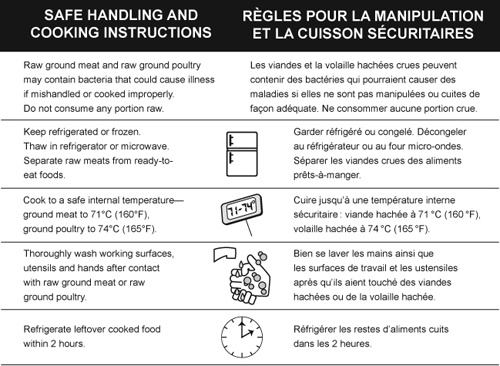
guide-cook-cuiss-meat-viand-01Santé Canada a publié de nouvelles lignes directrices sur l’étiquetage de viandes hachées relatives à leur préparation et cuisson. Ces lignes directrices visent à rendre plus uniforme l’information inscrite sur ces étiquettes et permettent de renseigner le consommateur sur les précautions à prendre pour manipuler et cuire ces viandes, notamment les températures de cuisson qu’il est nécessaire d’atteindre pour réduire le risque lié aux pathogènes alimentaires. Ces directives, lorsque suivies par l’industrie permettront d’uniformiser les étiquettes des viandes hachées offertes à la vente et contribueront ainsi aux efforts d’éducation et de dissémination de l’information auprès des consommateurs, sur les bonnes pratiques de manipulation et de cuisson de ces viandes.

An excellent Reference outlining “Risk Analysis in Food Regulations” made available by #FSANZ

A few months ago, Food Standards Australia New-Zealand (FSANZ) has made available a document outlining its approach in developing food standards, following a risk analysis approach.

The document entitled “Risk Analysis in Food Regulations” provides an excellent overview of FSANZ’s approach in addressing various food safety and nutrition hazards within the mandate of this bi-national food safety regulator, including the identification of food hazards and the associated risks, the assessment of these risks and the development of risk management measures and their implementation.

The reader of this document will rapidly note that FSANZ’s approach is very much aligned with the international food risk analysis principles adopted by the Codex Alimentarius Commission.

I was privileged to be given the opportunity to be one of the peer reviewers of this document, prior to its publication in January 2014. I consider this document as an excellent reference for food regulators and food stakeholders alike.

FSANZ is to be commanded for its enhanced transparency efforts and its leadership in making such a reference document available to all of us.